About Me
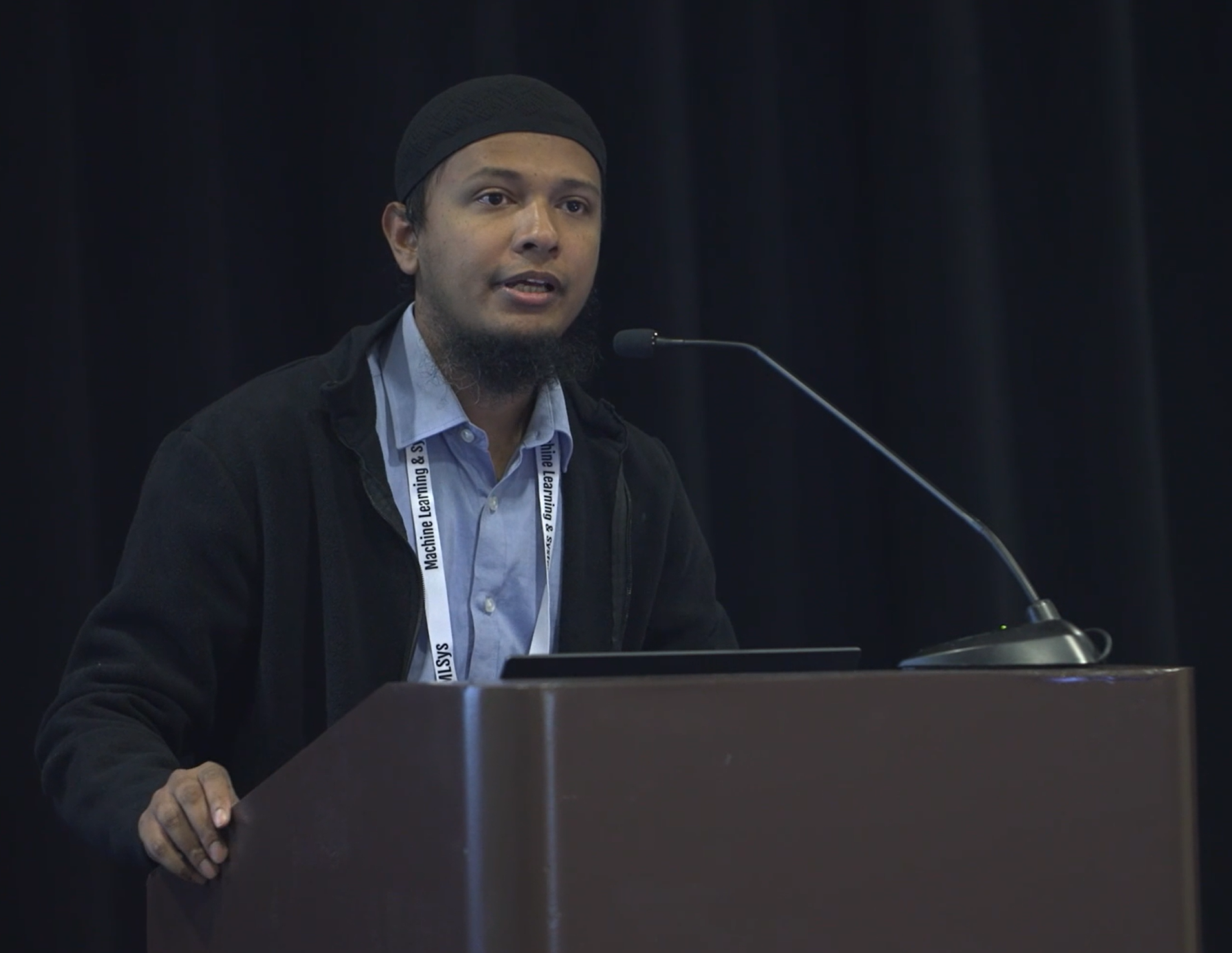
I am a PhD candidate in Computer Science & Engineering at Texas A&M University, focusing on high-performance and distributed machine learning systems, with expertise in sparse linear algebra, scalable ML infrastructure, and efficient GPU execution. My work spans academic research, industry, and national-lab collaboration, including internships at Amazon AWS (2025) and NVIDIA (2026) and ongoing collaboration with Oak Ridge National Laboratory. I am happy to have been invited to serve on the Program Committee for MLSys 2027.
After completing my PhD (tentatively at the end of Fall 2027), I plan to pursue industry roles as an ML systems engineer or researcher, focusing on building high-performance and scalable machine learning infrastructure.
I can:
Build custom PyTorch GNN training pipelines using optimized sparse linear algebra for scalable graph learning.
Integrate custom C++/CUDA kernels and systems APIs into PyTorch using LibTorch and PyBind11.
Develop distributed ML systems with PyTorch Distributed, including efficient disk-based data streaming for large-scale workloads.
Profile and optimize Python/C++/CUDA pipelines using NVIDIA Nsight Systems (NSYS), Nsight Compute (NCU), and IKET to identify kernel-level performance bottlenecks.
Apply ML and systems optimization techniques to develop efficient GPU kernels, MoE execution systems, and performance-tuning infrastructure, with optimizations deployed in production ML systems.
Prior to my PhD, I taught undergraduate courses for over 5 years, including in tenure-track roles, spanning computer systems, theory, and core programming, such as Web Programming, Computer Architecture, Theory of Computation, Programming Languages (C/C++/Java), and Data Structures & Algorithms.
Research Background
My PhD research focuses on scalable graph learning systems (GNNs, KGEs, and GraphRAG), high-performance sparse linear algebra, and efficient ML systems. At MLSys 2025, I presented a generalized method for expressing KGE training models through sparse matrix multiplication, achieving up to 5.3× training speedup on CPUs, 4.2× on GPUs, and 11.1× improvement in CUDA memory efficiency. I also developed a high-performance CPU SpMM library (ACM WebConf 2024) that accelerates PyTorch GNN training by up to 93× across Intel, AMD, and ARM CPUs.
During my Amazon Summer Internship in 2025, I developed a differentiable GPU kernel autotuner for MoE kernels, using transfer learning to improve prediction of optimal kernel configurations and reduce tuning time from days to hours.
During my NVIDIA internship in 2026, I worked with the cuDNN/FlashInfer team on MoE execution APIs and tuning infrastructure, with the resulting extensions integrated into FlashInfer v0.6.16. I also conducted system- and kernel-level performance analysis using Nsight Systems, Nsight Compute, and IKET to identify bottlenecks in CuTe DSL kernels and vLLM serving systems.
Currently, I am collaborating with Oak Ridge National Laboratory on a distributed, differentiable framework for large-scale KGE training across hybrid compute tiers.
Leadership Roles
I led and coordinated various academic and technical initiatives, including curriculum revisions, postgraduate programs, and programming contests at UIU, MIST, and BUET, fostering a culture of innovation and academic excellence across departments. See all my leadership roles and initiatives here.
Exploration
I deepen my ML systems expertise by solving LeetGPU problems across PyTorch, CUDA, and Triton, building intuition for low-level kernel design and performance trade-offs. I stay current with ML infrastructure and systems trends by developing small experimental tools and continuously expanding my software skill set, with 12+ open-source and commercial projects in Python, C++, and Java. I also regularly read and distill recent ML systems papers, sharing relevant hands-on tutorials and technical walkthroughs on my blog to communicate systems concepts clearly and effectively.